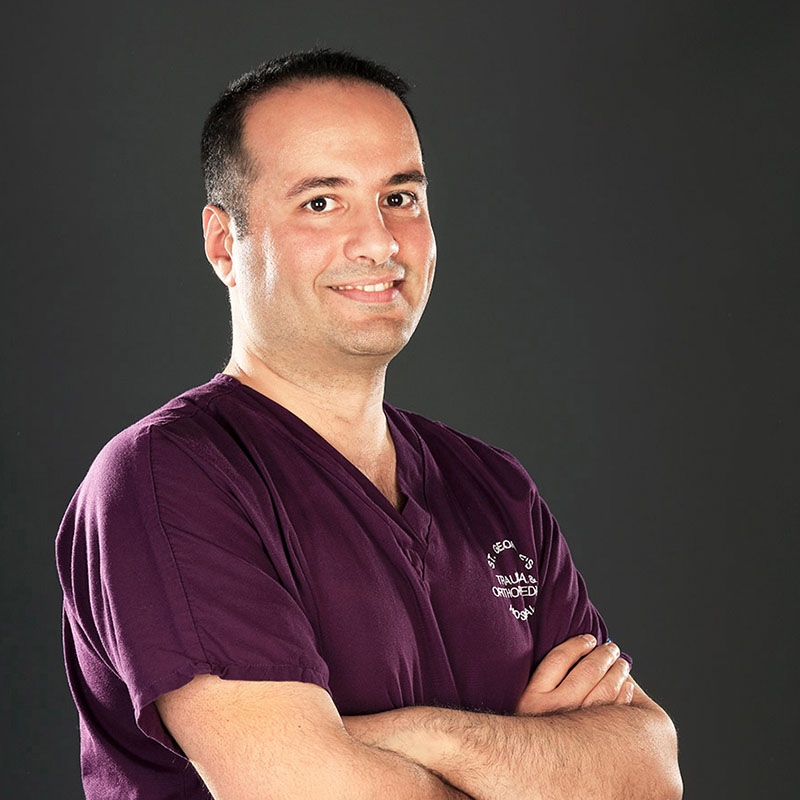
Revision Hip and Knee Surgery

Revision Hip and Knee Surgery with Mr Sulaiman Alazzawi

Revision hip and knee surgery is necessary when a joint replacement causes pain or discomfort. Mr Sulaiman Alazzawi is dedicated to delivering surgical excellence and unmatched aftercare, utilising implants with the highest safety records. His primary replacement procedures boast He has a remarkably low complication rate with his primary replacement procedure

As a member of a highly experienced multidisciplinary team, Mr Alazzawi who are referred and manage patients who are having problems with their artificial hips and knees. Not all joint replacement surgeons perform revision procedures due to their challenging nature, so the expertise of a specialised team is critical for an optimal outcome from revision joint replacement surgery.

Revision hip or knee surgery is inherently more demanding than the primary procedure, leading to an extended recovery period. Mr Alazzawi’s approach prioritises patient well-being and optimal outcomes throughout these intricate processes.

Custom made implant hip replacements

Even small deviations in hip anatomy can have a significant impact on the function of the hip joint. Standard hip replacement prostheses are available in a limited range of shapes and sizes and, although it is true that most patients are served perfectly well with these implants, some patients have an atypical anatomy that requires a custom-made implant.

For these patients, prostheses will be produced that are individually designed specifically for their unique hip geometry and Mr Alazzawi will use pre-operative 3D imaging software to plan precisely the size, shape, angle and length.

Why are joint replacements painful?

The longevity of hip and knee prostheses continues to extend as the technology improves, but wear can produce debris causing soft tissue reactions and bone breakdown. Reconstruction may require intricate techniques to address bone loss.

Bone defects in the pelvis can be dealt with by bone grafting, using the Exeter System or by the use of Tantalum, a special porous metal used in the Zimmer Trabecular Metal revision system. Custom-made implants may be necessary for severe cases.

Knee revision is often more challenging, as the soft tissues may be damaged as well as the bone. Surgery can involve using stemmed implants and porous metal for bone loss. Hinged components may be used when ligaments are damaged.

Revision hip or knee surgery is always more challenging than the primary procedure and patients typically have a longer recovery time. Often patients will be on crutches and not taking full weight on the leg for several weeks

Infections can occur immediately or only presents at a later date after joint replacement surgery.

A joint can become infected through the blood stream as a result of infection elsewhere such as a dental or urinary infection. You will usually feel pain and stiffness in the joint and it will often be warm to the touch and swollen. Diagnosis involves blood tests, scans, and joint fluid analysis. Surgical intervention is required, often as a one-stage operation with tailored antibiotic treatment.

Instability or dislocation is a relatively common problem after a joint replacement. The risk in the early stages is rare but it can occur later as components wear and the supporting muscles become lax. Surgery to reposition the component may be required and dual mobility bearings can be used for stability, providing successful results.

Post-fall fractures can cause loosening of the components. Surgery is almost always required and sometimes the bone can be fixed, retaining the implants, but more often replacement of the implant is required.

This is a rare but distressing issue after hip replacement. Management includes shoe raises, but surgery may be necessary, posing challenges as usually the components are well fixed to the bone and we risk damaging the bone taking them out.  In addition, the tissues are stretched by the lengthening of the leg, so there is an increased risk of dislocation after the operation.

Leading Hip & Knee Joint Replacement Specialist

Mr Sulaiman Alazzawi is a Consultant Orthopaedic and Trauma Surgeon based at St Georges University Hospital and the South West Elective Orthopaedic Centre in Epsom. He specialises in hip and knee replacements and treating painful joint replacements. His private practice is based at Fortius Clinic and Parkside Hospital in Wimbledon and Spire St Anthony’s Hospital in Sutton.

London Joint Replacement Specialist