Is a partial knee replacement right for you?

For many patients, joint replacement offers lasting relief when other treatments no longer help. However, not all knee replacements are the same. In some cases, a partial knee replacement may be the best option. This procedure targets only the damaged part of the knee rather than replacing the whole joint.
In this blog, we’ll explore the benefits of partial versus total knee replacement, what recovery typically looks like, and how new technology is helping patients get back on their feet faster.
Partial vs total knee replacement
The knee has three compartments including the inside (medial), the outside (lateral), and the area behind the kneecap (patellofemoral). In many patients, arthritis or cartilage damage affects just one of these compartments. When that happens, a partial knee replacement may be possible.
In surgery, only the damaged portion of the joint is removed and replaced with a prosthetic component, while leaving the healthy bone, cartilage, and ligaments untouched.
Partial knee replacements can offer some distinct advantages:
- Smaller incision and less tissue disruption compared with total replacement
- More natural knee function, since the healthy ligaments and cartilage remain intact
- Quicker recovery with less post-operative pain for many patients
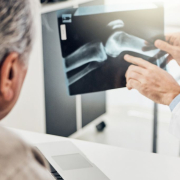
If arthritis is present in multiple compartments or the knee is unstable, a total replacement is usually the safer and more effective choice. Careful assessment with scans and clinical examination is essential to determine which option is right for you.
Partial knee replacement recovery
Recovery after partial knee replacement tends to be faster than after a total knee replacement, though every patient’s journey is unique. Many patients walk with crutches or a frame the day after surgery and progress quickly to walking aids like sticks. Within two to three weeks, it’s often possible to move around more independently.
Physiotherapy plays a central role in building strength and restoring movement. As the surgery is less invasive, muscles and soft tissues heal faster, and many people regain range of motion more quickly than with a total replacement. Low-impact activities such as cycling, swimming, and brisk walking can usually be reintroduced within a few months.
In terms of long-term outcomes, both partial and total replacements are effective in reducing pain and improving quality of life. However, some patients may eventually need a total replacement if arthritis develops in the other compartments of the knee.
MAKO partial knee replacement
Advances in surgical planning and robotic assistance are taking knee replacement, both partial and total, to the next level. Modern imaging techniques such as 3D CT scans allow surgeons to build a detailed map of your knee before the operation.
Robotic-assisted systems, such as the MAKO platform, use this 3D data to guide the surgeon during surgery. The robot doesn’t replace the surgeon; it acts as a highly accurate tool that ensures cuts are made with millimetre precision.
For partial knee replacement, where accuracy is especially important, this technology has been shown to improve implant alignment, reduce soft tissue damage, and support quicker recovery.
If you are unsure whether knee replacement surgery is right for you, book a consultation with Mr Alazzawi today for a thorough assessment.